


Beyond Symptoms: What P-tau181, GFAP and NfL Can Tell Us About Brain Health
When clients present with brain fog, memory concerns, poor concentration, cognitive fatigue or neurological symptoms, practitioners are often left asking the same question:
What is actually happening within the brain?
Historically, assessing brain health has been challenging. Practitioners have relied on symptoms, cognitive assessments, imaging studies or specialist referral pathways. While these approaches remain important, advances in biomarker testing are providing new opportunities to explore neurological health earlier and with greater precision.
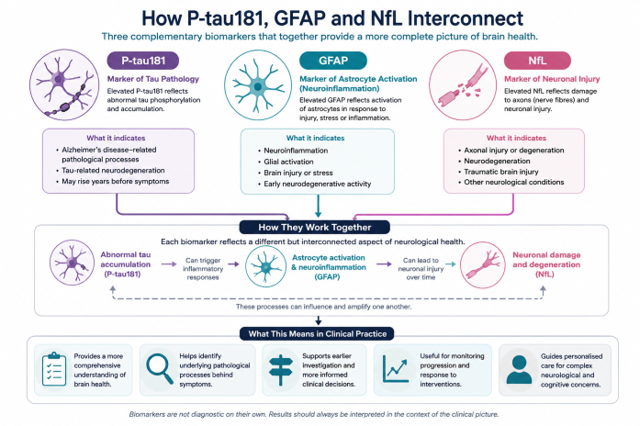
Three biomarkers receiving increasing attention are Phosphorylated Tau (P-tau181), Glial Fibrillary Acidic Protein (GFAP) and Neurofilament Light Chain (NfL) Together, these markers offer insight into different aspects of neurological function, injury and degeneration.
Why biomarkers matter
Many neurological conditions develop over years or even decades before a formal diagnosis is made. Clients may initially report brain fog, memory lapses, reduced concentration, cognitive fatigue, changes in processing speed, difficulties finding words or reduced resilience following illness or injury. These symptoms can have many causes, but they may also reflect underlying neurological stress or injury.
Biomarkers provide an additional layer of information that may help practitioners understand whether symptoms warrant further investigation.
P-tau181: A marker associated with tau pathology
Tau is a structural protein found within neurons. Under normal circumstances, tau helps stabilise neuronal architecture. However, when tau becomes abnormally phosphorylated, it can accumulate and contribute to neurodegenerative processes. P-tau181 has emerged as one of the most promising blood-based biomarkers associated with Alzheimer's disease pathology.
Research suggests elevated P-tau181 may reflect abnormal tau accumulation, correlate with amyloid-related pathology, rise years before clinical diagnosis and help differentiate Alzheimer's disease from some other forms of dementia. Importantly, P-tau181 is not a diagnostic test for Alzheimer's disease. Rather, it provides insight into whether Alzheimer's-related pathological processes may be occurring.
GFAP: A marker of astrocyte activation
Astrocytes are specialised support cells within the brain and nervous system. When the brain experiences injury, inflammation or stress, astrocytes become activated and release Glial Fibrillary Acidic Protein (GFAP). Elevated GFAP may indicate neuroinflammation, glial activation, brain injury or early neurodegenerative processes. GFAP has gained significant attention because studies suggest it may become elevated early in the development of Alzheimer's disease and other neurological conditions. For practitioners, GFAP can provide insight into whether neurological symptoms may be accompanied by ongoing neuroinflammatory activity.
NfL: A marker of neuronal injury
Neurofilament Light Chain (NfL) is a structural protein found within nerve fibres. When neurons become damaged, NfL is released into the bloodstream. Elevated NfL may indicate axonal injury, neurodegeneration, traumatic brain injury, multiple sclerosis, post-infectious neurological injury or other neurological disorders. Unlike P-tau181, NfL is not specific to Alzheimer's disease. Instead, it acts as a broader marker of neuronal damage and neurological stress. This makes it particularly useful when practitioners are exploring unexplained neurological symptoms, monitoring progression, or assessing recovery following injury.
Why these markers are powerful together
Each biomarker provides a different piece of the puzzle.
P-tau181asks whether Alzheimer's-related pathology may be present. GFAP asks whether the brain's support cells are responding to injury or inflammation and NfL asks whether neuronal injury or degeneration is occurring. Together they offer a more comprehensive view of neurological health than any single marker alone.
Which clients might benefit from assessment? These markers may be relevant when clients present with persistent brain fog, memory concerns, cognitive decline, family history of neurodegenerative diseases, neurological symptoms following infection, history of concussion or traumatic brain injury, unexplained cognitive fatigue and/or complex multi-system presentations affecting cognition. They may also be useful when practitioners are seeking objective data alongside clinical assessment and symptom evaluation.
The future of brain health assessment
The field of neurological biomarker testing is evolving rapidly. As research advances, blood-based biomarkers are increasingly moving from specialist research settings into clinical practice, providing practitioners with new tools to explore neurological function, neuroinflammation and neurodegenerative processes. While no single biomarker can provide a diagnosis, P-tau181, GFAP and NfL offer valuable insight into different aspects of brain health and may help guide further investigation when cognitive or neurological symptoms are present.
Understanding what lies beneath the symptom is often the first step towards making better clinical decisions.
Learn More
Colab Services offers access to advanced neurological biomarker testing, including P-tau181, GFAP and Neurofilament Light Chain (NfL), helping practitioners explore brain health through a functional and evidence-informed lens.
For more information, contact the Colab Services
team or speak with one of our clinical advisors.